

On Thursday, June 4th, 2026, the PDT rule officially goes away. This is arguably one of the biggest changes ever for retail traders with small accounts who have been restricted from day trading by the $25,000 minimum account balance requirement.
With the rule change, all options traders with at least $2,000 can open and close as many day trades as their account’s real-time risk exposure allows, and are no longer limited to only three day trades every five business days.
Now that PDT is ending, many traders (including me!) will likely become more active in day trading and reevaluate how to approach 0DTE options trading — including which ticker symbol makes the most sense for their account size, risk tolerance, and position management preferences.
What tickers offer 0DTE options?
Currently, five ticker symbols list daily option expirations:
- SPY: SPDR S&P 500 ETF Trust
- QQQ: Invesco QQQ Trust
- SPX: S&P 500 Index
- XSP: S&P 500 Mini-SPX Index
- NDX: Nasdaq 100 Index
In addition, many popular stocks and ETFs now offer options contracts every Monday, Wednesday, and Friday, including AAPL, AMZN, NVDA, and more.
SPX vs SPY comparison
SPY and SPX are two popular day trading symbols that track the S&P 500. Both tickers are highly liquid instruments with tradable options. SPY is an ETF, and SPX is an index. While they have many similarities, there are some key differences that options traders need to understand.
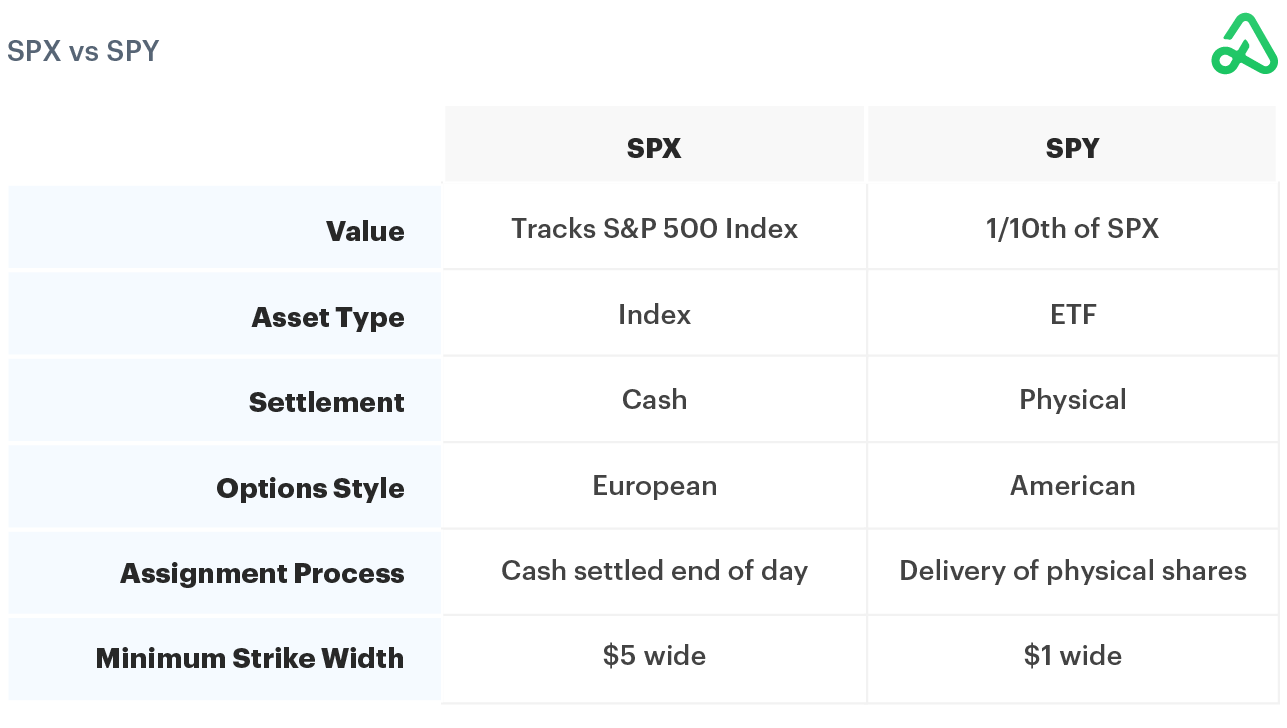
Key takeaways:
- SPX may appeal to traders wanting cash settlement with no worry of closing positions before the end of the day.
- SPY may appeal to traders seeking greater flexibility in position sizing and lower risk.
- Neither is inherently “better.” The right choice depends on account size, risk tolerance, and trade management preferences.
Commissions and fees
Commissions, fees, and assignment costs must also be considered when evaluating ticker symbol selection.
Equity and index options are often subject to different commission and fee structures, which can significantly impact long-term trading costs for active traders. While some brokers charge per-contract commissions on all options trades, others offer reduced pricing for certain products, but may assess assignment or exercise fees.
For traders using Option Alpha, select broker integrations offer exclusive commission-free pricing on equity options, while all brokers charge a commission on index options (as well as regulatory fees that are passed through to the trader). The comparison below highlights the current commission and assignment fee structures across several popular brokers, including fees for index options such as SPX and XSP.
.png)
Traders need to factor in these costs – and their impact on net P/L – when choosing what product best fits their strategy and account. For example, trading SPY or QQQ may have $0 commissions, but they’ll require early management to avoid assignment. Alternatively, index options can be held until expiration., but may have a higher cost (commissions are charged for open and closing orders). However, you may be charged an assignment fee if your option(s) expire in the money.
Backtesting SPX & SPY positions
Backtesting is a data-driven way to compare the results of using SPX and SPY for similar strategy settings.
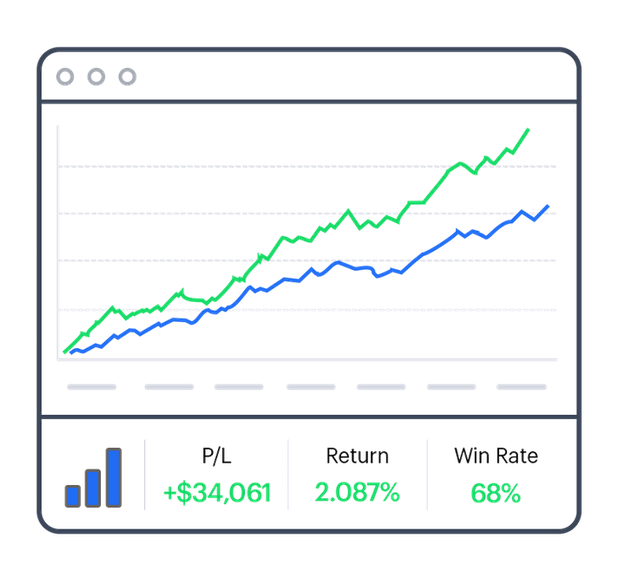
Below is a look at a 60-minute Opening Range Breakout strategy with SPX and SPY. Both strategies trigger a short put spread on a break of the 60-min opening range high.
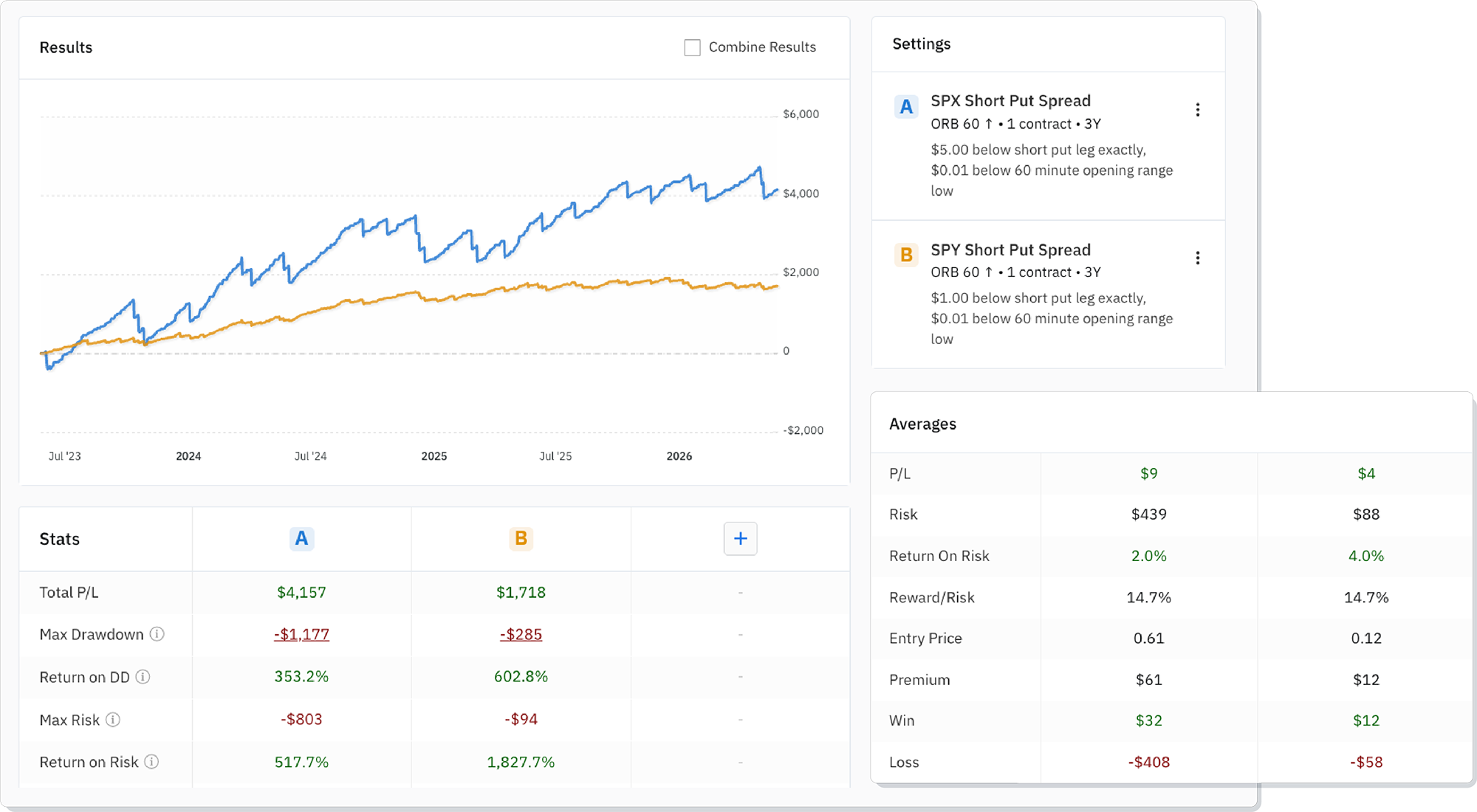
Two very different results for the same strategy setup. While the SPX version made more money, it experienced a much sharper drawdown and greater volatility during the backtest.
Depending on your risk tolerance and sensitivity to volatile returns, you’ll want to consider these elements when choosing which ticker to use.
Also note the significant differences in position averages. SPX had a much higher average risk and loss per trade.
Again, neither symbol is ‘better,’ but it’s important to understand the pros and cons of each and how it relates to you and your account.
Key takeaway:
- The same strategy can produce very different outcomes depending on the ticker used.
- Higher returns don't always mean a better trading experience.
- Drawdowns, average loss size, and equity curve volatility matter just as much as total profit.
Ready to automate your day trading? Start a Free 30-Day Trial Here
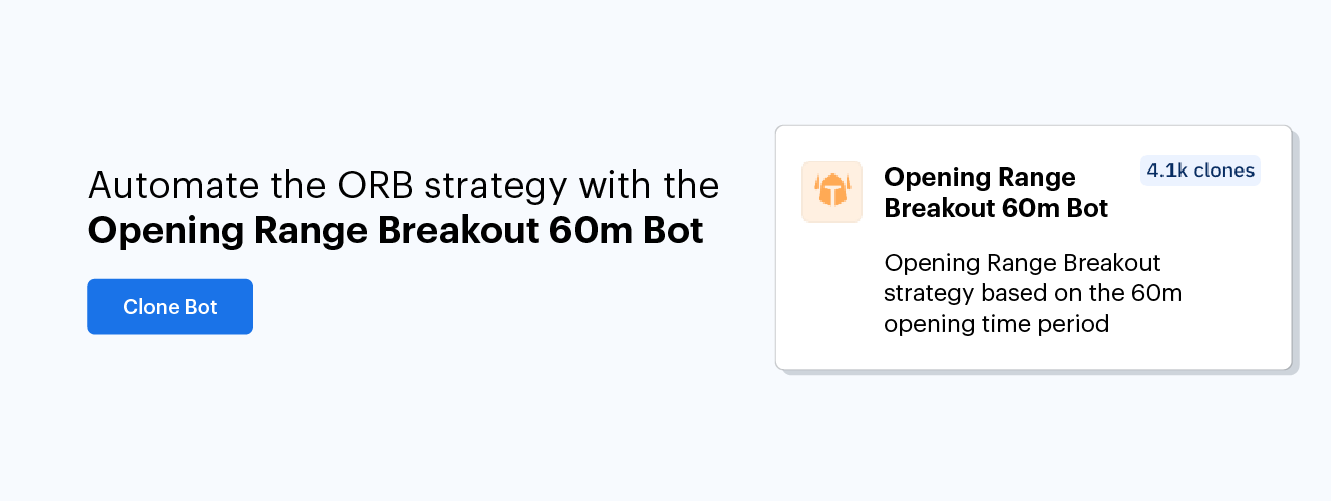
The Opening Range Breakout 60m Bot automates an opening range breakout similar to the backtests above. The bot and backtest use SPX by default, but you can change the ticker and test different variations.
You can view and clone the bot template here:
Understanding the difference between index options and equity options
There is no ‘right’ or ‘wrong’ ticker to use, but what symbol you choose should depend on your risk tolerance and an understanding of the underlying symbol’s option contract properties.
Cash-Settlement vs Physical Settlement
Index options, such as SPX, are cash-settled. This means that when the options expire, profits and losses are credited or debited directly to the account as cash transactions, with no exchange of underlying shares.
For example, if you sell a 7,500/7,495 SPX short put spread for a credit of $2.00, and SPX closes below 7,495, you will lose -$300, but have no risk of being assigned shares. If SPX closes above 7,500, you’ll keep the $200 premium. If SPX closes at 7,498.50, you’ll profit $50 (7,500 - 7498.50 = $1.50. $2.00 - $1.50 = +$50.
Conversely, ETF and equity options have physical settlement, meaning traders are obligated to take on actual shares if the short option is assigned. For example, if you are assigned one SPY short put contract, you’d be long 100 shares of SPY at the option’s strike price. Options expiring in-the-money are automatically subject to assignment.
Key takeaway:
- SPX positions settle in cash.
- SPY positions can result in share assignment.
- SPY traders will need to close positions before expiration if they want to avoid assignment of shares.
Selecting a 0DTE ticker symbol
The end of the PDT rule gives traders more flexibility when choosing which tickers to use. Position sizing and risk should be one of the primary factors when choosing a ticker.
SPX may fit traders who:
- Prefer cash settlement
- Want no assignment risk
- Trade larger account sizes
- Prefer wider spreads and larger premium collection
SPY may fit traders who:
- Have smaller accounts
- Want smaller position sizing
- Prefer tighter spread widths
- Are comfortable actively managing positions
SPX offers a $5-wide minimum strike price interval, which often results in positions with a higher risk-per-trade. Traders with small accounts may not want to take on so much risk for a single position. A SPY option position can have much less risk, but would require you to close the position prior to expiration to avoid assignment.
Below is a look at a 0DTE option chain for SPX and SPY.
- SPX strike prices are typically $5 apart.
- SPY strike prices are typically $1 apart.
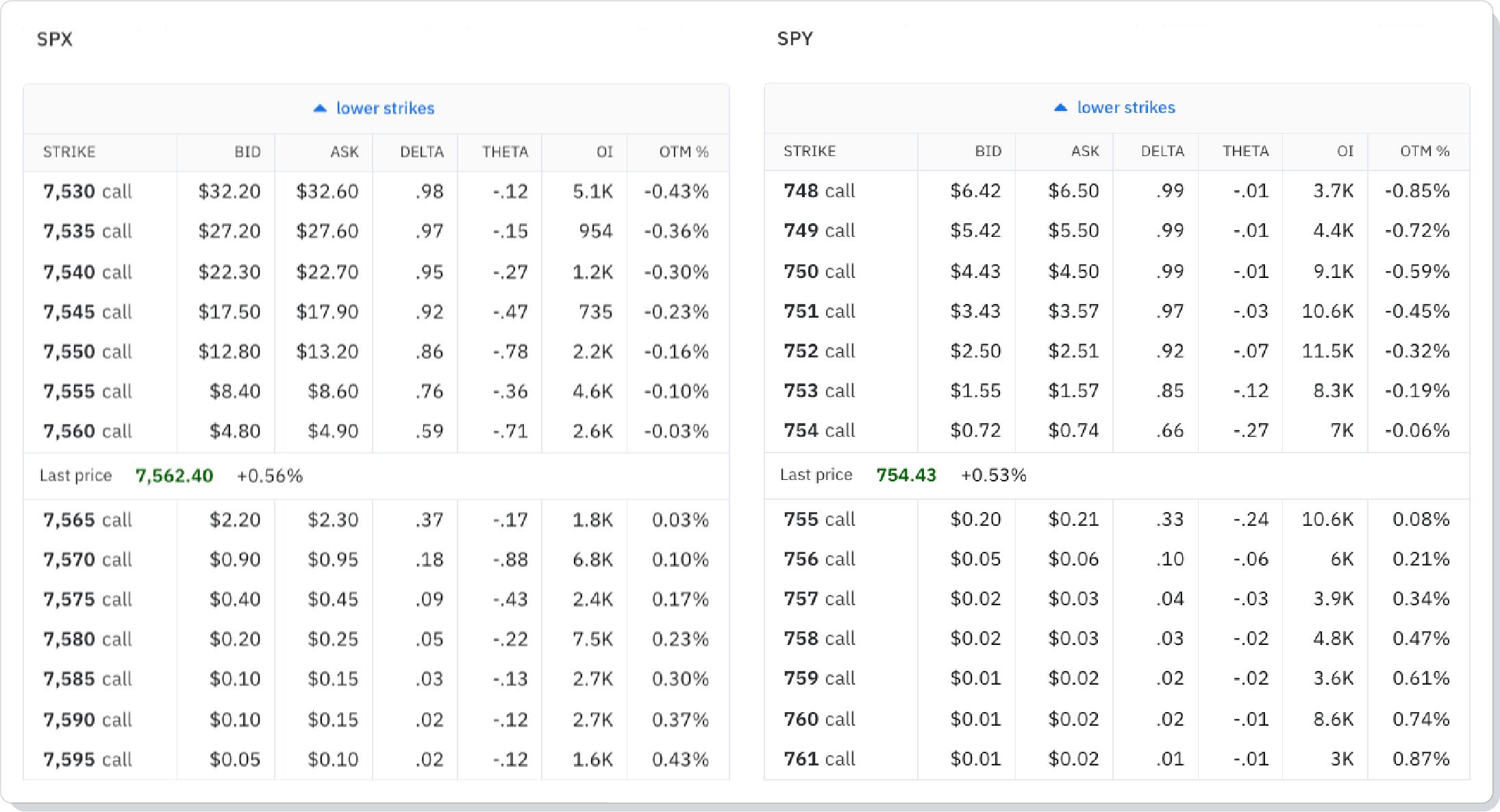
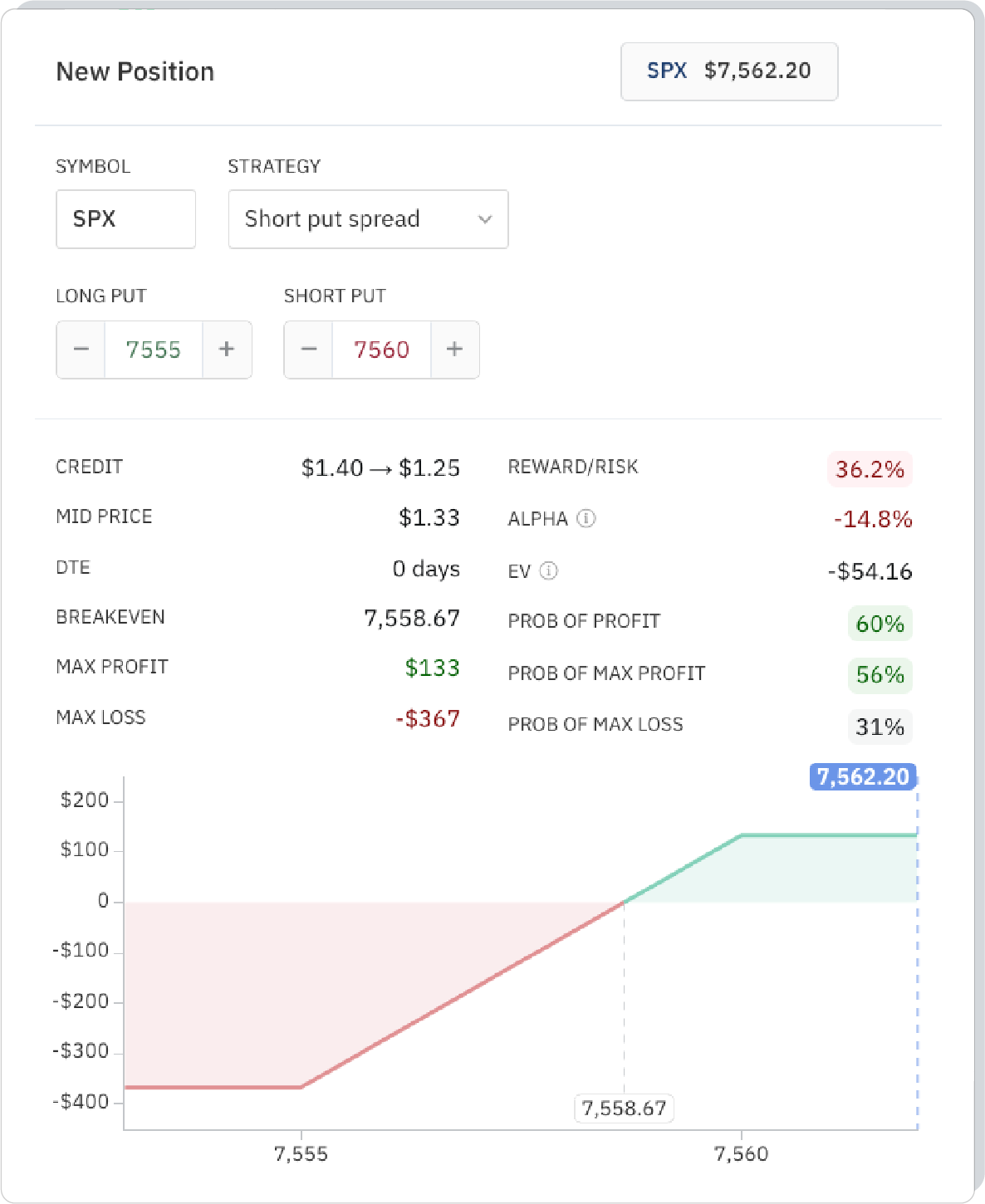
The strike price intervals have a direct impact on the selected position’s reward/risk profile. For example, an at-the-money, $5-wide short put spread in SPX offers much higher potential profit, but more risk:
Conversely, an ATM short put spread in SPY can be entered with a $1 wide spread. The max profit and max loss reflect the smaller spread width:
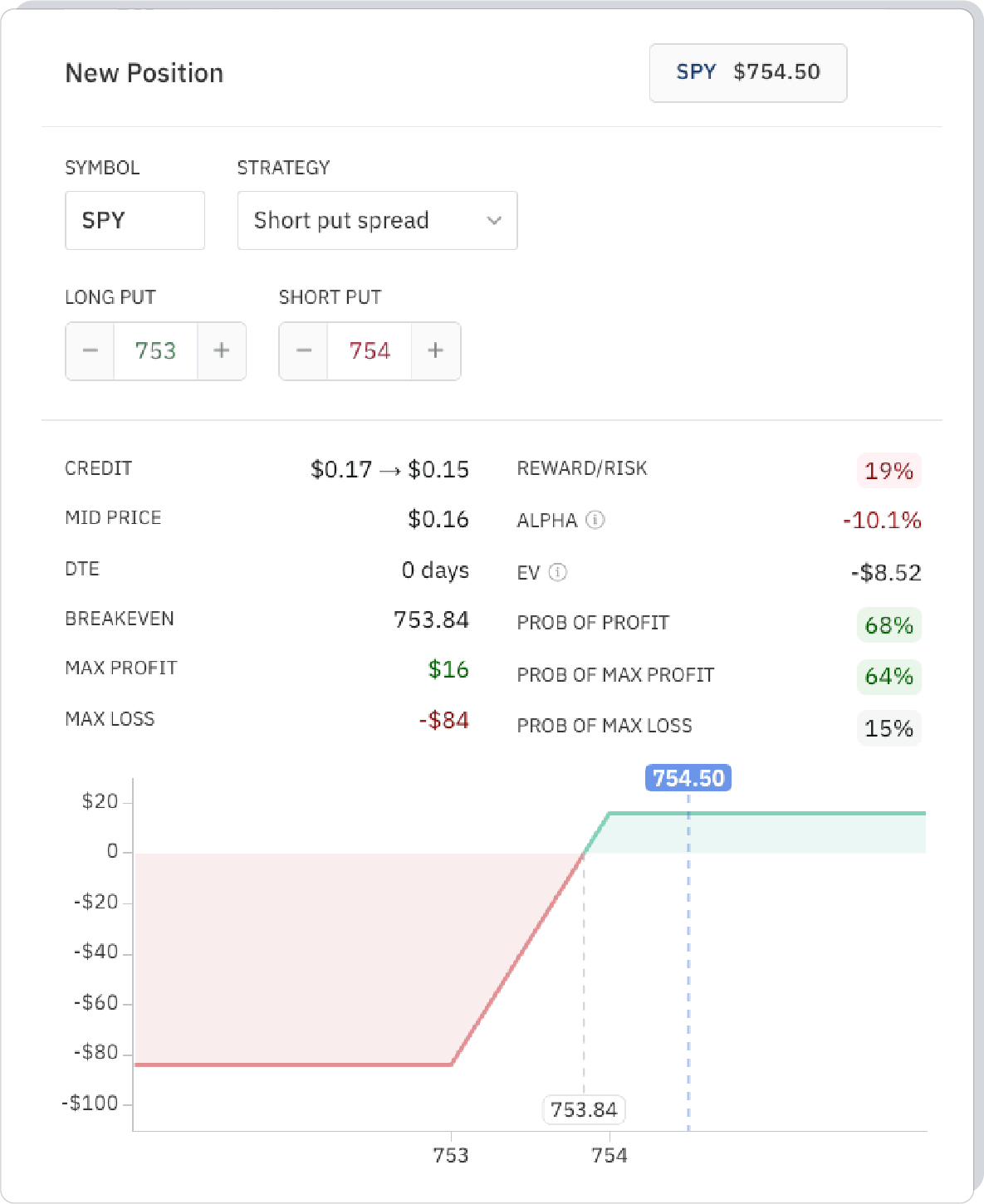
Why is this important? If you have a small account of $5,000, a single position with $400 of risk is nearly 10% of your account size. While the smaller risk of an SPY position may better fit your portfolio management. With PDT removed, traders can now actively manage all positions throughout the day without restriction.
How the PDT rule change impacts SPX vs SPY trade management
It’s not just limited to the ticker symbol characteristics, either. The removal of PDT allows traders to manage trades, such as exiting early at a predefined profit target, which can affect the long-term results of a 0DTE strategy. Traders should consider the benefits and drawbacks of holding positions until expiration or exiting trades early, while also remembering how index options and equity options differ at settlement as noted above.
Looking at the same SPX ORB strategy, Test A had no exit option creitera applied; the trade was held until expiration. Test B included a 50% profit target. The total P/L for both was nearly identical.
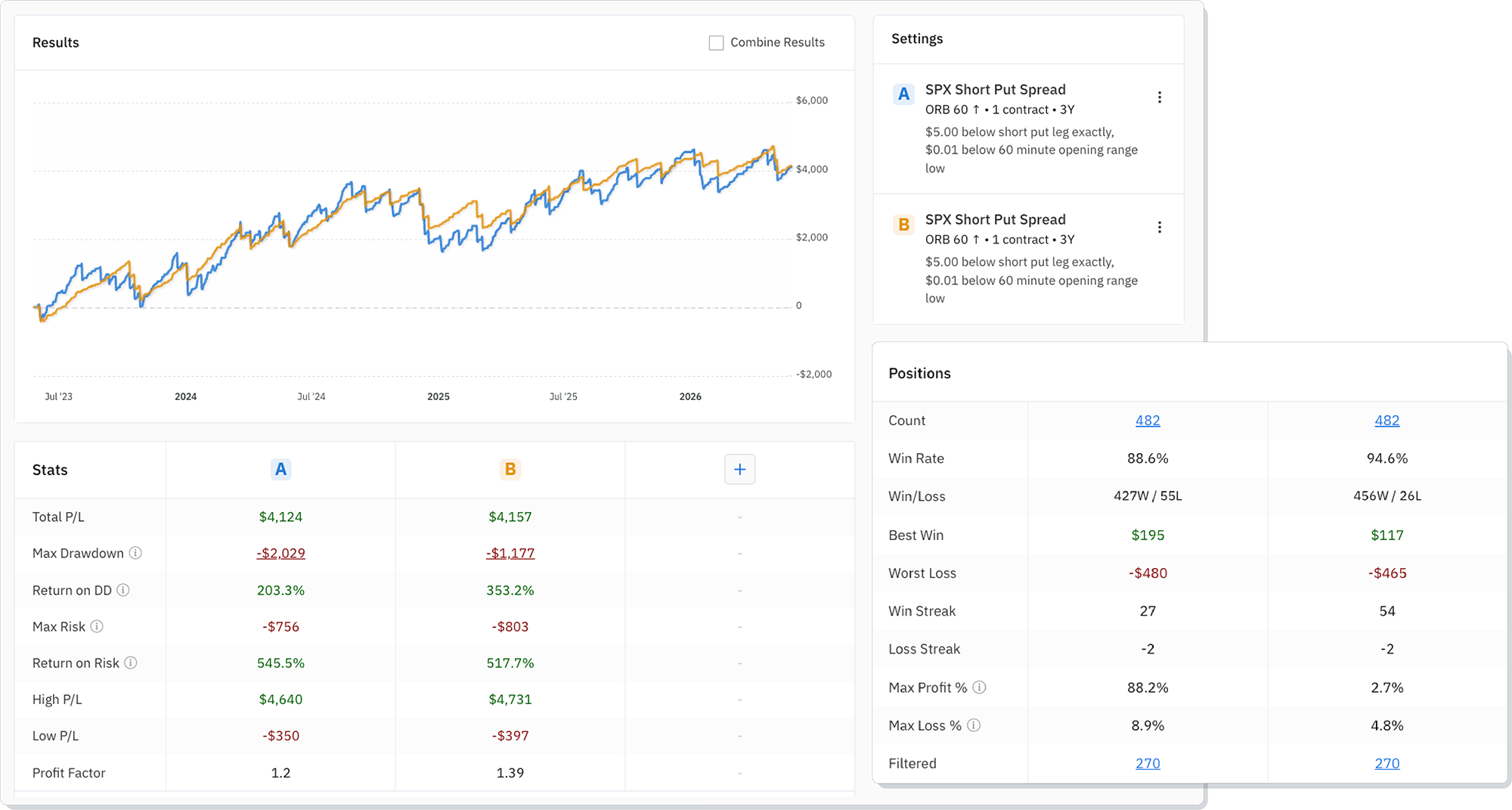
However, using a profit target cut the drawdown in half and increased the profit factor, while also smoothing out the equity curve with a bit less volatility. Win rate and win streaks also increased, while the number of positions experiencing the max loss dropped in half.
With the ability to close positions early, the backtest shows variations that may help your trading psychology by managing trades with early exits.
Tax Treatment for index options vs equity options
In the United States, SPX options are classified under section 1256 and qualify for the 60/40 tax rule, which allows 60% of gains to be taxed as long-term capital gains and only 40% as short-term. This means gains or losses when trading SPX are treated as a mixture of short-term and long-term capital gains, regardless of how long the security was held.
SPY and other stock/ETF options do not benefit from the 60/40 tax rule and are therefore subject to traditional capital gains taxes and holding times for short-term vs. long-term gains.
Final Thoughts
The removal of the PDT rule gives traders far more flexibility in how they structure and manage 0DTE positions. But flexibility alone doesn’t create consistency.
Whether you choose SPX or SPY, the key is understanding how each product behaves, how much risk each position introduces, and how trade management decisions affect long-term results.
The best way to evaluate those tradeoffs is through backtesting and having a plan before risking real capital.



.png)



'%3e%3cg id='Final-Copy-2_2_' transform='translate(1275.000000, 200.000000)'%3e%3cpath class='st0' d='M7.4,12.8h6.8l3.1-11.6H7.4C4.2,1.2,1.6,3.8,1.6,7S4.2,12.8,7.4,12.8z'/%3e%3c/g%3e%3c/g%3e%3c/g%3e%3cg id='final---dec.11-2020'%3e%3cg id='_x30_208-our-toggle' transform='translate(-1275.000000, -200.000000)'%3e%3cg id='Final-Copy-2' transform='translate(1275.000000, 200.000000)'%3e%3cpath class='st1' d='M22.6,0H7.4c-3.9,0-7,3.1-7,7s3.1,7,7,7h15.2c3.9,0,7-3.1,7-7S26.4,0,22.6,0z M1.6,7c0-3.2,2.6-5.8,5.8-5.8 h9.9l-3.1,11.6H7.4C4.2,12.8,1.6,10.2,1.6,7z'/%3e%3cpath id='x' class='st2' d='M24.6,4c0.2,0.2,0.2,0.6,0,0.8l0,0L22.5,7l2.2,2.2c0.2,0.2,0.2,0.6,0,0.8c-0.2,0.2-0.6,0.2-0.8,0 l0,0l-2.2-2.2L19.5,10c-0.2,0.2-0.6,0.2-0.8,0c-0.2-0.2-0.2-0.6,0-0.8l0,0L20.8,7l-2.2-2.2c-0.2-0.2-0.2-0.6,0-0.8 c0.2-0.2,0.6-0.2,0.8,0l0,0l2.2,2.2L23.8,4C24,3.8,24.4,3.8,24.6,4z'/%3e%3cpath id='y' class='st3' d='M12.7,4.1c0.2,0.2,0.3,0.6,0.1,0.8l0,0L8.6,9.8C8.5,9.9,8.4,10,8.3,10c-0.2,0.1-0.5,0.1-0.7-0.1l0,0 L5.4,7.7c-0.2-0.2-0.2-0.6,0-0.8c0.2-0.2,0.6-0.2,0.8,0l0,0L8,8.6l3.8-4.5C12,3.9,12.4,3.9,12.7,4.1z'/%3e%3c/g%3e%3c/g%3e%3c/g%3e%3c/g%3e%3c/svg%3e) Your Privacy Choices
Your Privacy Choices